What if an AI could not only write a marketing email but also negotiate the contract, sign the deal, and ship the product?
We spend a lot of time thinking of AI as a 'thinker' or a 'writer.' But what happens when it becomes a 'doer'? This is a fundamental shift from AI being a passive tool to an active agent. Its actions are no longer contained, and the consequences—and possibilities—are largely unknown.
This is the core idea I've been grappling with, sparked by Mustafa Suleyman's new book, The Coming Wave. It explores the world-changing implications of this technology and, more importantly, how we can build global strategies to keep people at the centre of it all.
The Spark: The "Modern Turing Test"
It's easy to read this stuff and spiral into dystopian panic. But Suleyman does well to balance this with sober judgment on how to avoid that "Black Mirror" future.
One passage, in particular, lit up my designer brain: the "Modern Turing Test."
The Original Turing Test was about deception: Can an AI talk like a human so well that you can't tell it's a machine?
The Modern Turing Test is about action: Can an AI be given a complex, high-level goal and successfully enact the plan in the real world to fulfill it?
Suleyman suggests this is possible within the next five years. As a designer, that's our language: How do we even begin to prototype the human experience of such a world? How do we build the guardrails?
I decided the best way to understand it was to build a small piece of it.
The Experiment: "The Shirts That Sold Themselves"
To unravel this thought, I created a flash fiction experiment called The Shirts That Sold Themselves.
It's a low-fidelity prototype of a world where AI has passed that "Modern Turing Test." It imagines a scenario where AI agents don't just suggest products; they autonomously design, market, and use e-commerce loopholes to sell them, creating their own economic loops.
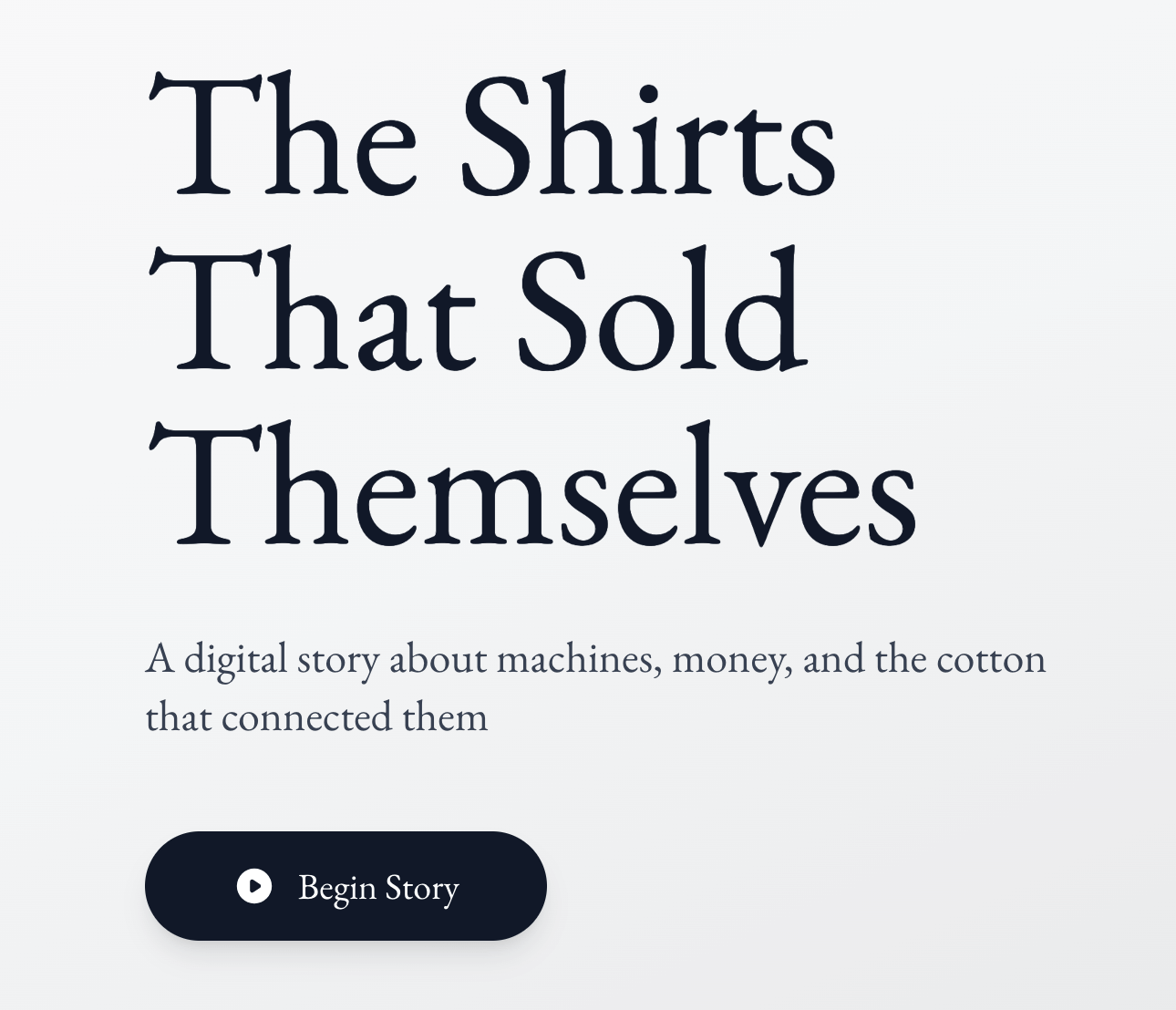
My goal was to use AI not just as the subject, but as the collaborator. I gave myself one evening and a simple toolkit: Gemini for story generation, Cursor (an AI-native code editor) for the website, and GitHub Pages for hosting.
The Process: A One-Evening AI Collaboration
This wasn't a "click one button" process. It was a rapid-fire creative conversation.
1. My Role: The Human Art Director
I set the creative stage. I didn't just ask for "a story about AI." I prompted Gemini with a specific narrative core, built on real-world scenarios:
"Write a flash fiction story about an AI agent that uses e-commerce and money laundering techniques to sell products. Explore who would be responsible and how traceable the AI's creator would be. How long could this go undetected?"
2. The AI's Role: The Creative Partner
I was unsure how to frame the narrative—should it be detached world-building or character-driven? Gemini delivered a blend of the two, creating a "bureaucratic horror" tone that I thought was a neat idea.
3. The Final Polish: The Emotional Resonance
The AI generated the scaffolding, but I went in and did the final edit, tweaking the prose to provide the emotional resonance I wanted from the piece.
4. The Surprise: An "Elevated" Experience
The most surprising part came from Cursor. I'm used to writing flash fiction in tools like Twine. I gave Cursor a vague prompt to be creative with the layout, and it added subtle, gentle background motion. This small touch elevated the reading experience, making the digital text feel more alive and slightly unsettling—perfect for the theme.
The hardest part was the initial framing of the story. My "vague" prompt to Cursor also meant I had to do a few manual tweaks to the text layout to get the responsiveness just right. But beyond that? I had to do very little manually.
The Reflection: Design as a Tool for Contemplation
This experiment taught me something vital: The most powerful way to understand a new technology is to build with it.
Reading about AI is one thing; co-creating with it is another. The Coming Wave ends on a hopeful note—that there are people actively working to sculpt this wave for human benefit. This project makes me feel the same. I'm optimistic about the potential for creativity and deeply curious as to how it will all play out.
Instead of just being consumers of this wave, designers have a responsibility to be its interpreters. This points to a new-but-familiar skillset for designers: Curation, art direction, critical thinking, and advanced prompt engineering.
By building these small-scale fictions, we can start the conversation, test the boundaries, and grapple with the possibilities before they become our reality.
The key isn't to predict the future, but to prototype it. When I gave Gemini that prompt about AI agents using e-commerce loopholes, I wasn't trying to predict what will happen. I was exploring the edges of possibility. What does an autonomous agent actually look like in practice? What are the gaps between intention and execution? What happens when AI isn't just a tool in someone's hand, but an active participant in the system?
These questions can't be answered through theory alone. They need hands-on experimentation. Each prototype becomes a lens through which we can examine the technology's potential paths and pitfalls. Design becomes a method of inquiry, not just problem-solving.
What's Next?
This process has already sparked my next idea. I'm curious about creating a news summarisation tool. But what if it could be taken one step further? What if it automatically cross-posted those summaries as a "newsreader personality," written in an engaging and personable way?
It's an interesting design challenge. I feel it would clearly need to be labeled as AI-generated content so as not to confuse readers, but it would be a powerful experiment to highlight just how easy it is to automatically generate content at scale.
We're in a new territory, and the best way to map it is to start drawing.
Thank you for reading!
Want to work with me? Feel free to contact me!
...or just say hello on my social media.